
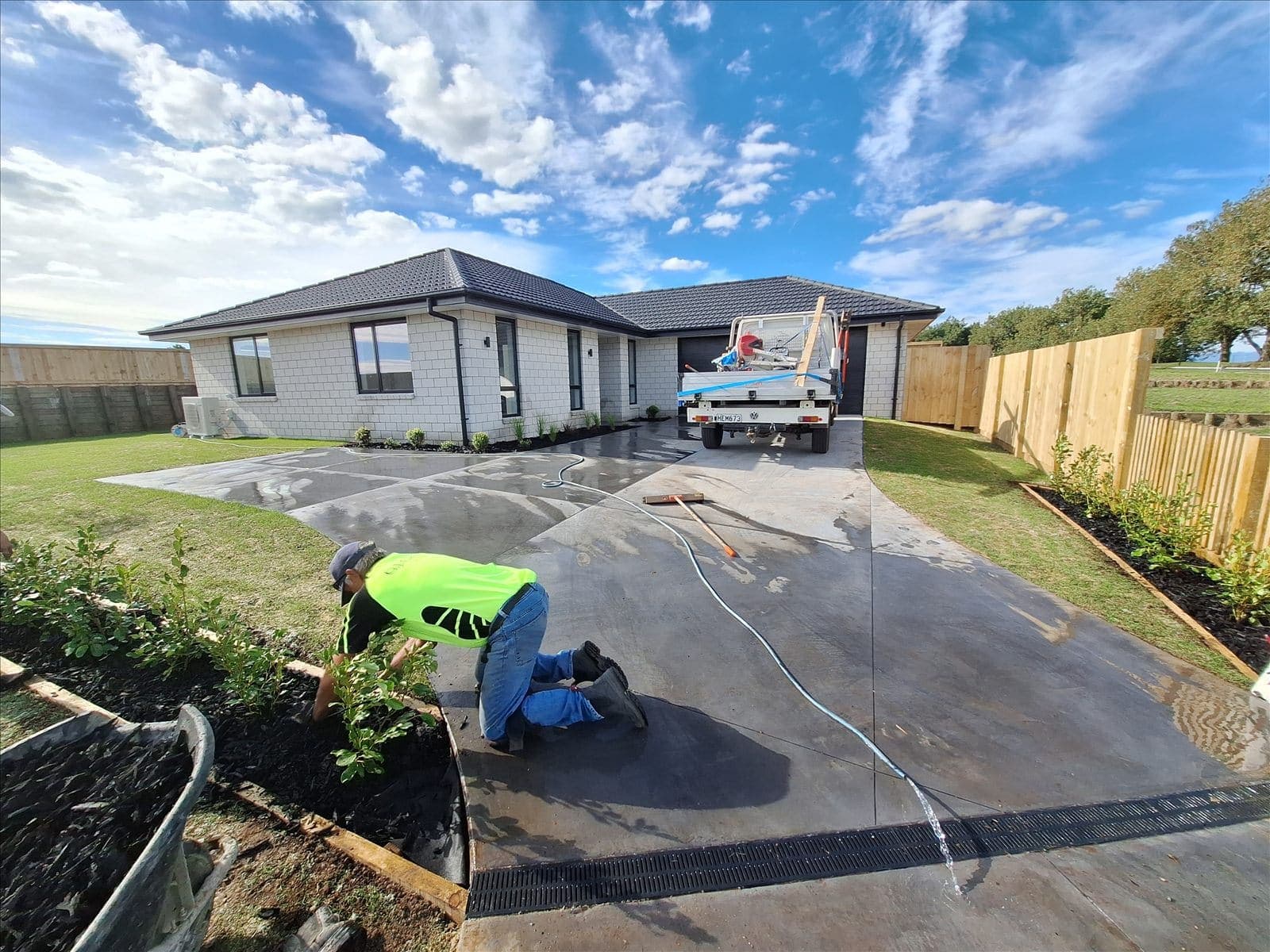
Urban new-build, garden edges going in while the driveway finishes curing underneath.
Quick answer: wait 24-48 hours before walking on new concrete, 7 days before driving a normal car on it, and 28 days before anything heavy. At 7 days it’s only reached about 65-75% of its full strength. Exposed aggregate needs the same clock, treated with more patience.
We pour concrete driveways across Hamilton and the Waikato, and the handover-day question is always some version of this one. The honest answer has three different numbers in it depending on what you’re asking, and almost nobody online gives you all three - they give you one, round it up, and let you find out the hard way which one you actually needed.
So here’s the whole thing: what the numbers actually mean, why two of them disagree with each other depending which site you land on, what actually breaks if you jump the gun, and the one finish that needs longer than the rest.
The numbers, with no rounding
Three stages, three completely different reasons to care about each one. Nobody’s in a hurry to drive across a slab that’s still closer to porridge than pavement, but everyone’s in a hurry to know exactly when they stop having to care.
| Stage | Wait | What's actually happening |
|---|---|---|
| Walking | 24-48 hours | Set enough for light foot traffic without leaving a mark |
| Driving (light vehicles) | 7 days | Around 65-75% of full design strength |
| Heavy vehicles, trailers | 14-28 days | The safe range - see the disagreement below |
| Full design strength | 28 days | About 99% - the industry's own testing cutoff, not the finish line |
Both Concrete Network and the New Zealand Concrete Contractors Association land on the same figure for that middle row, worded almost identically: a newly poured driveway shouldn’t be used for seven days. That’s two organisations on opposite sides of the planet, with no reason to copy each other’s homework, arriving at the exact same week. When that happens in concrete, it’s worth believing.
The heavy-vehicle row is where it gets messy, and I’m not going to pretend it isn’t. Slab Lab in Auckland says 14 days is enough for trailers and towing. Most everyone else - Concrete Network included - holds the line at 28. Nobody actually explains the gap in writing, which is its own kind of honesty: I’d rather a source admit “we don’t fully agree on this one” than invent a tidy explanation that sounds confident and isn’t.
My read, and it’s a read, not a citation: 14 days is probably fine for a ute or a light trailer, and 28 is the number you want in your head for anything genuinely heavy, like a moving truck or plant on the property. Split the difference in your favour, not the concrete’s.
Why 7 days, why 28 - the 28-day myth
28 days sounds like a horror movie because, structurally speaking, it kind of is one - something is quietly getting stronger the whole time, and by the time anyone notices, it’s basically finished without you.
Here’s what’s actually happening underneath your driveway, day by day, per published engineering strength-by-age figures:
| Age | % of 28-day strength |
|---|---|
| 1 day | 16% |
| 3 days | 40% |
| 7 days | 65% |
| 14 days | 90% |
| 28 days | 99% |
Look at that jump between day 3 and day 7 - 40% to 65% in four days. That’s not a typo, it’s just how concrete works: most of the strength arrives early, then the gains get slower and harder-won, the same way the first 5kg comes off easy and the last 2kg takes a personal grudge against you.
And here’s the part almost nobody says: 28 days isn’t when concrete finishes getting strong. It’s when the industry got tired of waiting to test it. Per Eric Barger, a civil engineer writing for the National Precast Concrete Association, 28 days was chosen as “the standard specimen age to establish consistency for testing procedures throughout the industry” - a scheduling decision, not a chemistry one.
Concrete keeps hydrating for years, at a rate so slow it stops being useful to measure. Someone had to draw a line for the paperwork. They drew it at 28 days, and forty years of contractor blogs have quietly rounded that up to “fully cured,” which it isn’t. It’s just where everyone agreed to stop watching.
What actually happens if you drive on it early
Nobody drives across wet concrete on purpose. What actually happens is smaller and dumber than that: a trade’s ute needs to get past it, a delivery truck backs up the driveway instead of the berm, or someone just forgets it’s day 4 and not day 8. The damage doesn’t care which excuse you had.
The escalation runs in one direction, per Concrete Network, and it only gets worse from here:
| What you get | How bad |
|---|---|
| Tire tracks, footprints, scuff marks | Cosmetic - the mildest outcome, still avoidable |
| Rutting or displacement | The surface visibly deforms under the tire weight |
| Cracking | Permanent - not “get it patched” permanent, actually permanent |
If you want a sense of scale for what “too soon” can cost, a driver in Minnesota once took a genuine run-up across a freshly poured municipal street, roughly 1,000 feet of it, and racked up an estimated USD $100,000 in damage, according to authorities. That’s a US city street, not a Hamilton driveway - the dollar figure won’t translate directly - but the physics translates fine: fresh concrete under a moving tire loses in every version of this story.
One detail worth knowing before you get comfortable at day 8: the edges of a driveway cure slower and weaker than the middle of the slab, because they don’t have the same mass or support holding them up from the sides. Some contractors backfill the edges with soil early specifically to give them something to lean on. Worth remembering next time you’re tempted to park with two wheels on the grass and two on the very last inch of driveway - that inch is the one part of the pour that was never trying to be tough.
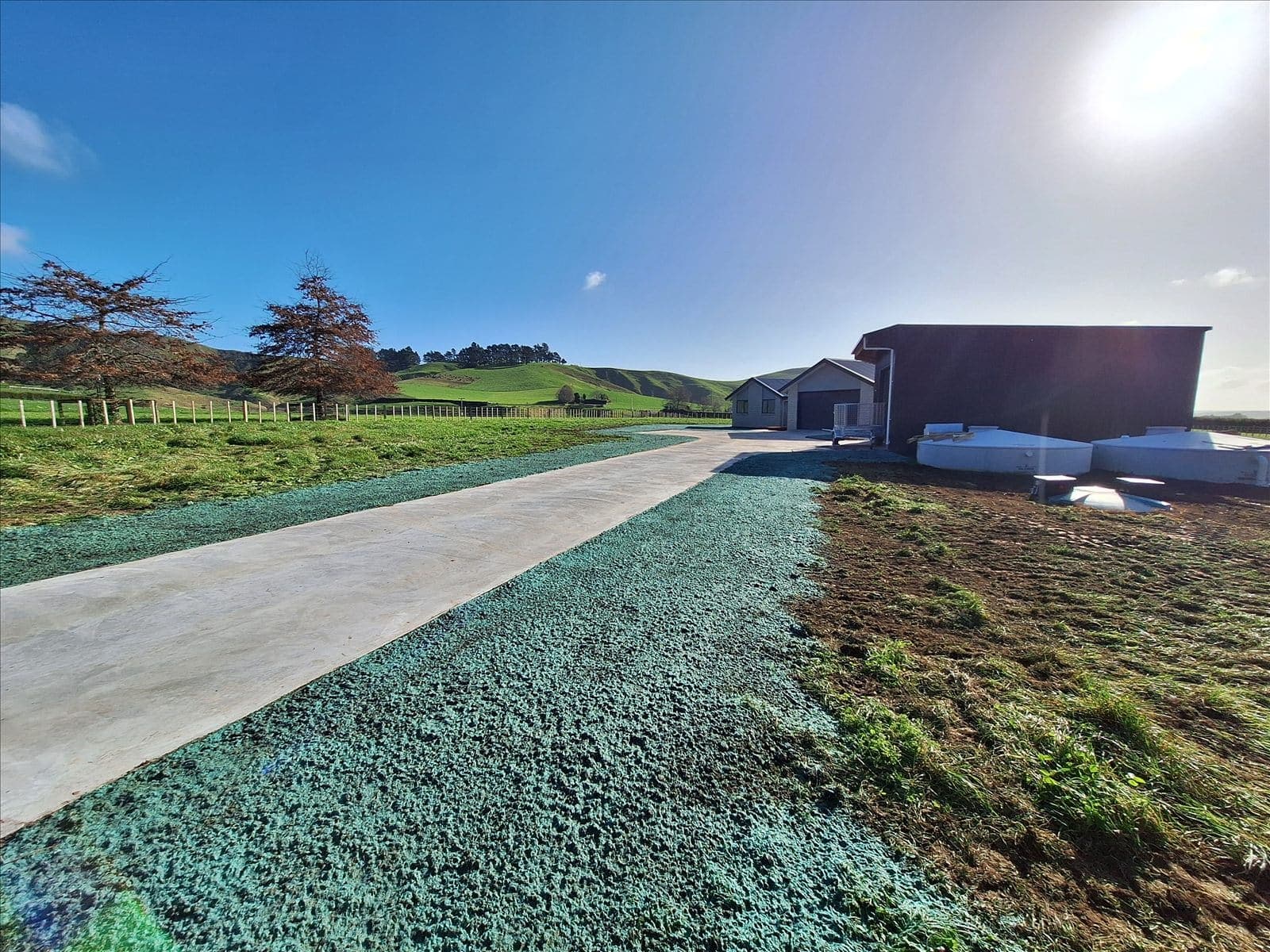
Hydroseeded either side of a rural driveway, curing on its own clock while the lawn catches up.
Curing isn’t drying - the mistake everyone makes
This is the one bit of chemistry actually worth knowing, because it’s the thing that tricks people into driving early with a totally clear conscience.
Drying is water leaving the surface. Curing is a chemical reaction - cement and water reacting to build the crystal structure that gives concrete its strength. A driveway can look bone dry within hours and still be chemically a teenager underneath: technically capable of holding weight, extremely unwilling to actually do it well.
Per NPCA staff engineer Evan Gurley, the internal humidity of the slab needs to stay above 80% for the first seven days for hydration to happen properly - which is the entire reason concreters mist, cover or spray new pours instead of just leaving them to dry in the sun and calling it done. Let the surface dry out too fast during that window and you can lose up to half the intended strength, a figure repeated widely enough across the concrete industry to count as consensus, even without one single study everyone points back to.
So the eye test lies to you twice: once when the surface looks dry at 12 hours and isn’t ready to walk on, and again when it looks completely finished at day 5 and isn’t remotely ready to drive on.
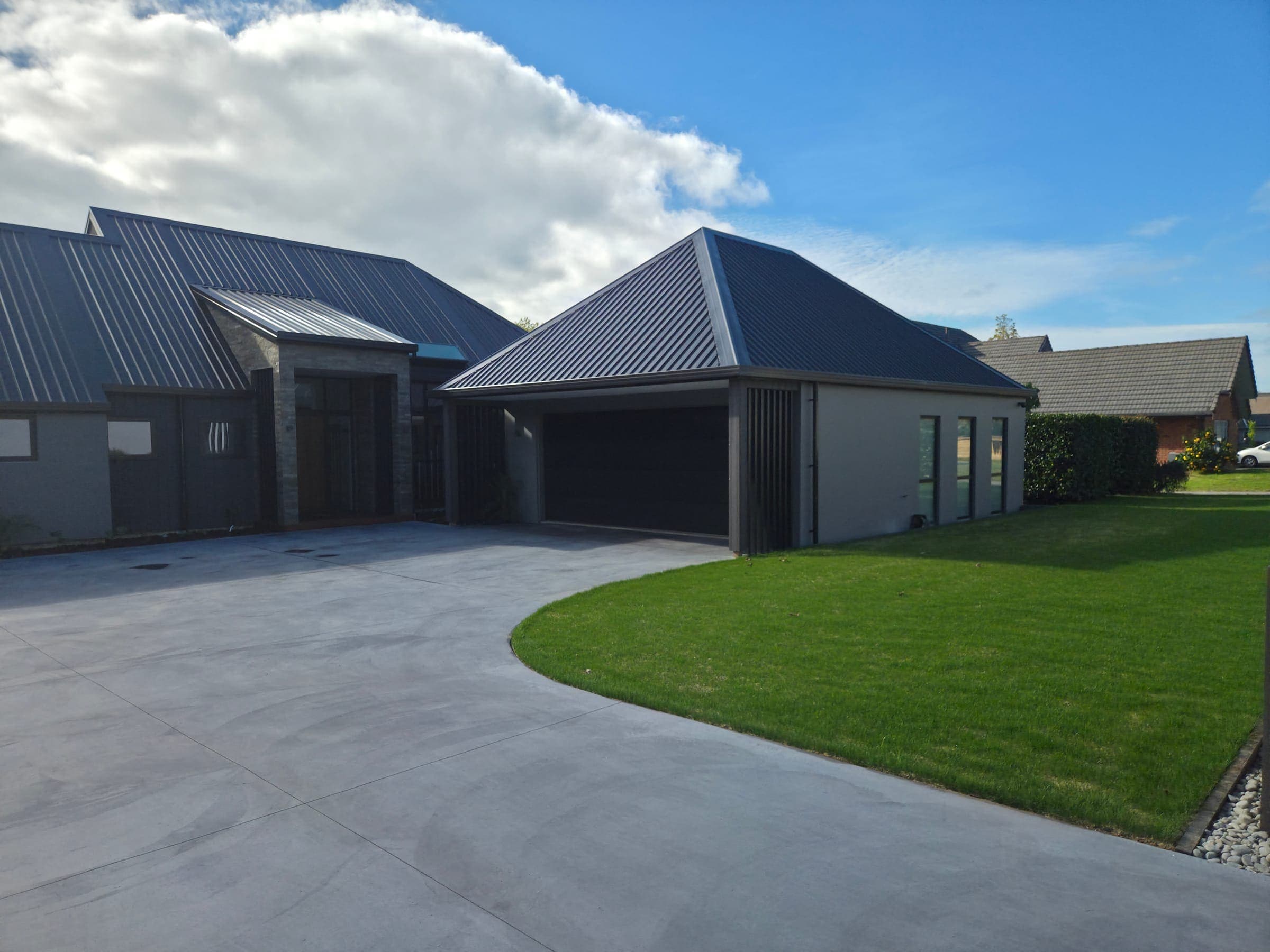
This is the finish line. Every fresh pour looks nothing like this for the first week, and every fresh pour eventually looks exactly like this.
Rain, heat and cold on a fresh pour
Waikato weather has never read a blog post about ideal curing conditions, and it’s not about to start now.
Rain in the first few hours after a pour is the real risk window - it can mark or wash the surface before it’s set enough to resist it. By the 24-48 hour mark, a pour handles normal rain without drama, which is most of why concreters watch the forecast obsessively for pour day and mostly stop caring about it a couple of days later.
| Condition | Effect on curing |
|---|---|
| Rain, first few hours | Can mark or wash out the surface before it sets |
| Cold, below about 4-5°C | Hydration all but stops - a normal Waikato winter morning |
| Heat, fast surface drying | Cracking risk if the top dries before the concrete underneath cures |
Neither extreme does you any favours. The whole reason “wait 7 days” is a range and not a single sacred number is weather like this - Waikato doesn’t owe your driveway a mild week just because you’ve got plans for the weekend.
Exposed aggregate needs more patience, not less
Exposed aggregate is one of the finishes we get asked for most in the Waikato - it copes with wet conditions better underfoot than a plain broom finish, which matters here more than most places in the country. It also asks more of the curing window than a standard driveway does, not less, and that surprises people who assume “more textured” means “more forgiving.”
The stones in an exposed aggregate finish sit proud of the surface with only a thin ring of mortar holding each one at the edges - closer to a mosaic than a slab, at least for the first week, and about as forgiving as one if you drop a tile on it early. Loading it too soon doesn’t just risk the usual tire tracks. It risks individual stones popping loose one at a time, and once a driveway’s missing a stone it looks less like “textured finish” and more like a jigsaw puzzle someone gave up on halfway through.
The structural clock is identical to any driveway. What changes is how carefully you treat the surface during that window:
| Plain broom finish | Exposed aggregate | |
|---|---|---|
| Foot traffic | Fine from about 48 hours | Keep off for the full 7 days |
| Surface care | Left to its own devices | Kept damp, out of direct sun |
| Structural clock | 7 days light, 28 full | Same - 7 days light, 28 full |
That extra care is practitioner habit built up across a lot of Waikato driveways, not a documented industry standard with a certificate attached - but it’s the habit that keeps stones where they were placed instead of in the gutter.
| The recap | Short answer |
|---|---|
| Walk on it | 24-48 hours |
| Drive on it (light vehicles) | 7 days |
| Heavy vehicles, trailers | 14-28 days - lean toward 28 |
| Exposed aggregate | Same clock, extra care for the full 7 days |
FAQ
Getting a driveway poured and want the real timeline for your site, not a rounded-off guess? See our concrete driveways page for how we run a pour end to end, or get a free, no-obligation quote - we’ll tell you straight what your site needs and when you get your driveway back.