
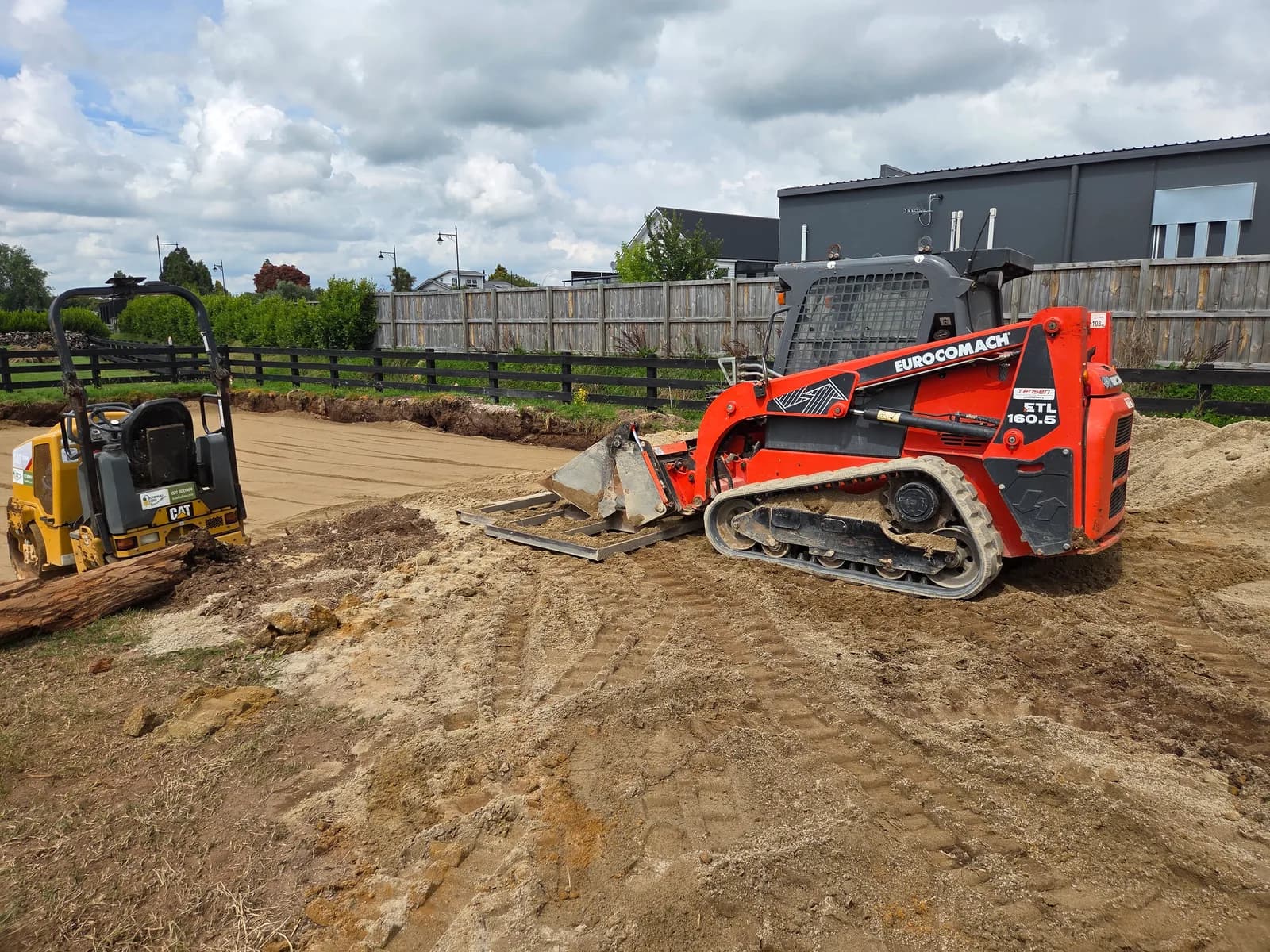
Somewhere between “clearing the section” and “resource consent,” most homeowners realise nobody told them where that line actually sits.
Quick answer: sometimes - and the honest, slightly annoying truth is that the answer depends entirely on which council your property sits in, not on a single national rule. Every regional and district council in New Zealand sets its own volume, slope and waterway thresholds for what counts as a permitted activity versus what needs a resource consent.
Somewhere, right now, a homeowner is standing on their own section, looking at a bobcat, wondering if moving that pile of dirt over there is a Tuesday afternoon job or a Resource Management Act event. Both are technically possible answers, and the internet is not going to give you a single number, because there genuinely isn’t one.
We run bobcats and diggers across Hamilton and the Waikato most weeks, so here’s the actual shape of the rule - what it depends on, one real regional example so you can see how it’s written, and exactly where to check yours.
Why there's no single national number
Earthworks are governed by the Resource Management Act, but the RMA hands the actual rule-writing job down to regional and district councils - which means Auckland, Wellington, Bay of Plenty and the Waikato each wrote their own answer to “how much dirt can you move before we want to know about it.” Nobody coordinated. Nobody was ever going to.
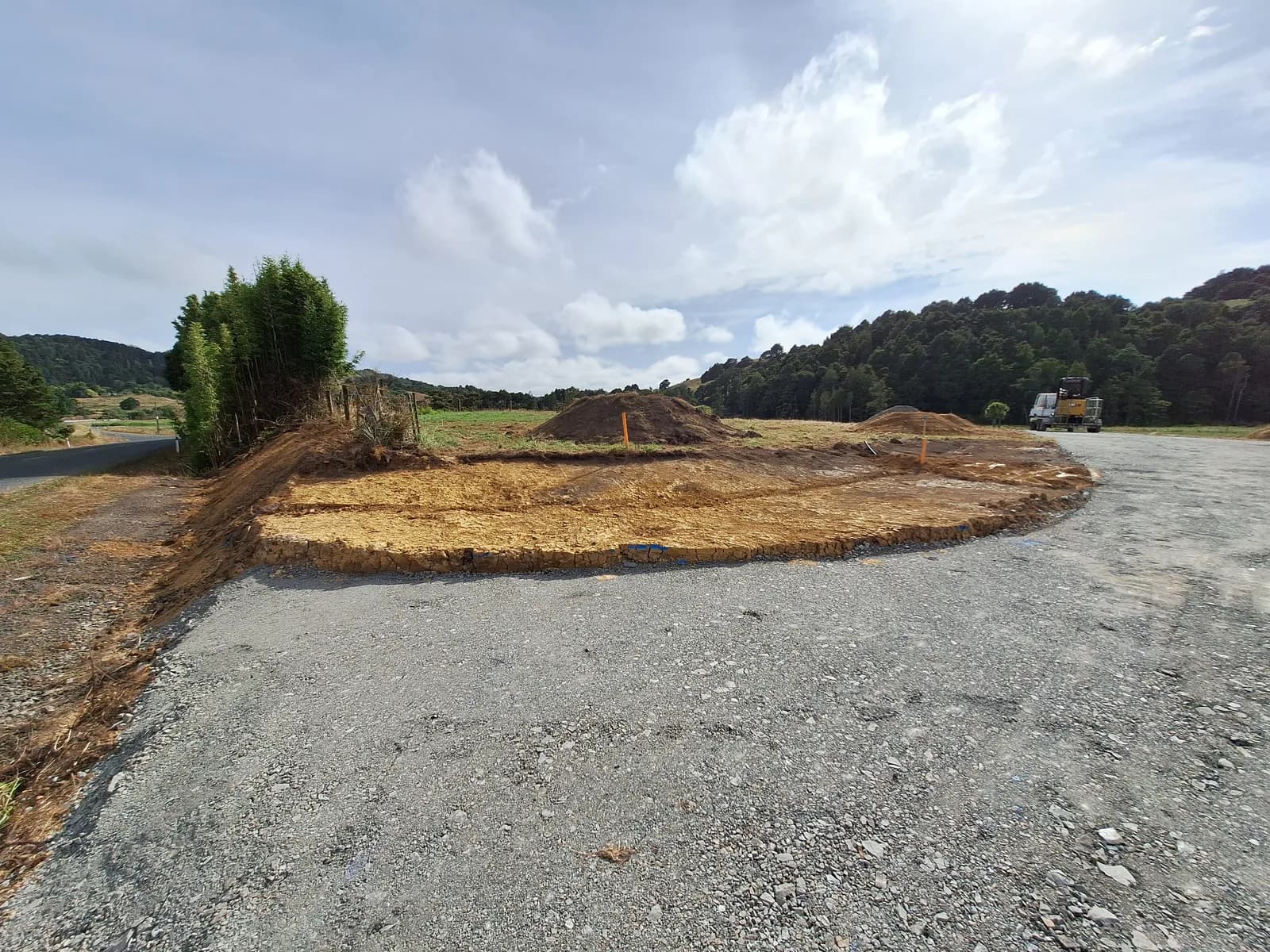
Most of what gets called “landscaping” starts with a section that looked like this a week earlier.
It’s the same reason two neighbouring councils can have wildly different rubbish bin colours - each one is a genuinely separate body making its own call, and dirt, like bin day, didn’t get a memo asking it to be consistent.
You often need to clear two sets of rules, not one: your regional council (erosion, sediment and waterway effects) and your district council (land use and site-specific effects) can both have a say on the same pile of dirt, from two completely different angles.
What actually pushes a job over the line
Different councils, same handful of ingredients. Every set of rules we’ve looked at cares about some combination of these:
| Factor | Why it matters |
|---|---|
| Area of exposed earth | More bare dirt means more erosion risk while it sits uncovered |
| Volume moved per year | A running annual total, not just one job in isolation |
| Distance from a stream, drain or wetland | Sediment reaching water is the effect councils police hardest |
| Slope of the site | Steep land sheds sediment faster and is harder to stabilise |
| What's in the ground | Contaminated fill (old landfill, treated timber offcuts) gets treated more seriously than clean soil |
Notice what’s not on that list: how big the job looks, or how long the digger’s been on site. A small, deep dig two metres from a drain can trip more rules than a large, shallow level-off in the middle of a paddock.
One real example, so you can see the shape
Numbers help more than descriptions, so here’s one real, current rule - not the Waikato’s, but genuinely useful for seeing how these are actually written. Under Greater Wellington Regional Council’s Rule 101, a property can carry out up to 3,000m² of earthworks per year as a permitted activity, provided it meets a set of conditions around erosion and sediment control. Go over that area, miss a condition, or work close enough to a waterway, and the same job needs a resource consent instead.
| Greater Wellington, Rule 101 | Detail |
|---|---|
| Permitted area | Up to 3,000m² per property, per year |
| Condition | Subject to erosion and sediment control conditions |
| Over the limit or near water? | Resource consent required |
That’s Wellington’s number, for Wellington’s soil, slopes and waterways. It exists to show you the shape of the rule - an area limit, an annual total, a set of conditions - not to tell you what your own section is allowed to move. That part’s next.
Checking the Waikato's actual rule
For anything in Hamilton or the wider Waikato, the regional rules for earthworks - sediment, erosion and waterway effects - sit with Waikato Regional Council’s own earthworks page, and the district-level land-use side sits with Hamilton City Council or your local district council, depending on where the property actually is.
We’re not going to print a specific cubic-metre figure here and hope it’s still right by the time you read it - plan changes happen, and a number that was true in 2024 doesn’t automatically survive to 2026. What we will say: if your job involves more than clearing a garden bed or levelling a small patch for a shed, it’s worth a phone call before the digger turns up, not after.
Demolition and clearing count too
People picture “earthworks” as fresh digging, but clearing an old, messy section counts just the same - and it’s often the bigger job of the two. We took on exactly this for a Hamilton homeowner: two old buildings came down, truckloads of concrete and landfill left the site, and the whole section got levelled with fresh topsoil, ready for the lawn that went in after.
That kind of job moves real volume and can turn up contaminated fill nobody knew was under there - which is exactly the combination that pushes a job from “permitted” to “better check first,” regardless of which council you’re in.
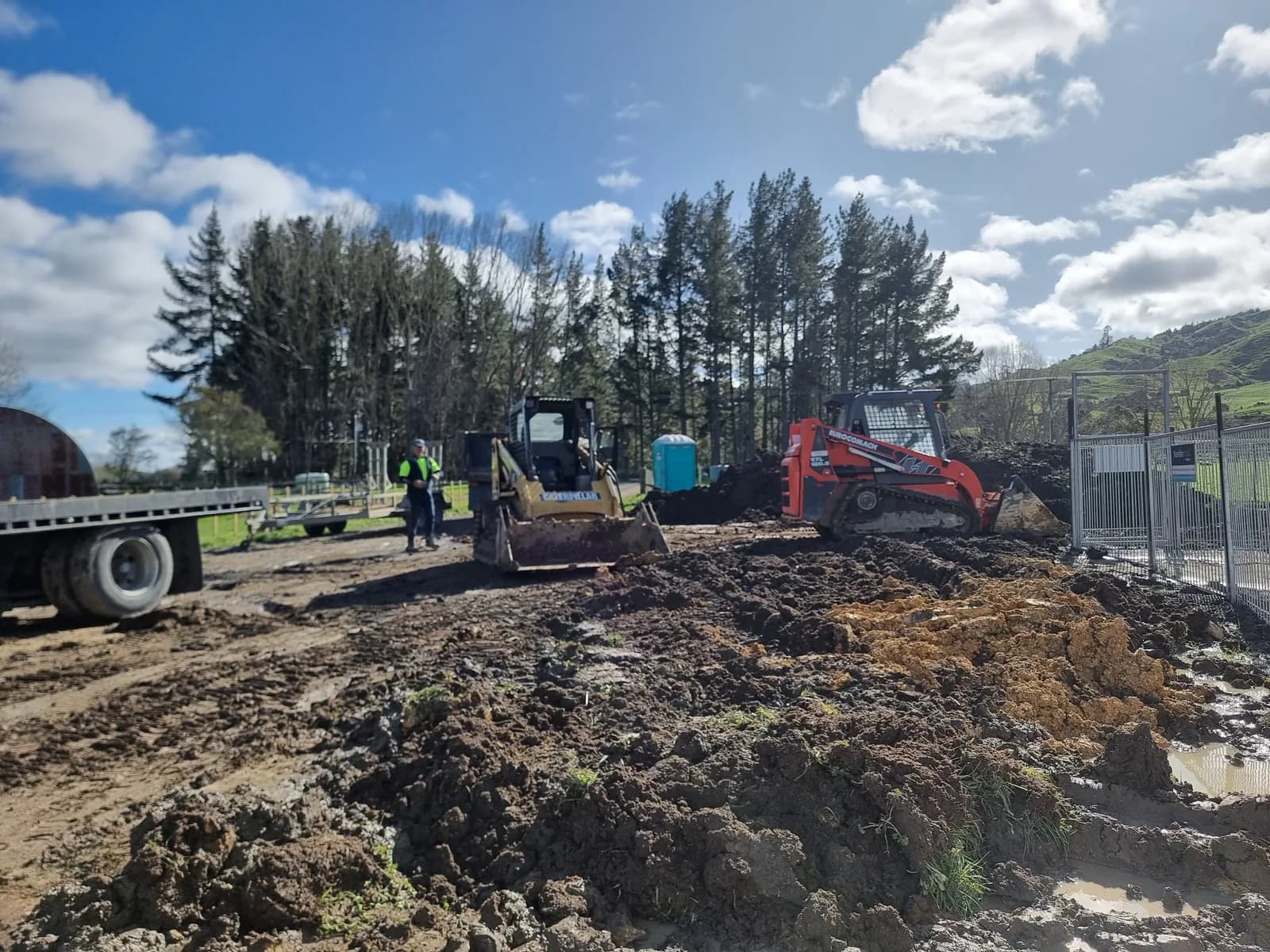
This is what “moving some dirt around” actually looks like from the seat of the digger - stockpiles, mud, and a fence crew working around it.
What happens if you skip it
The consequence isn’t a strongly worded letter. Under the RMA, council can issue an abatement notice ordering the work to stop immediately, mid-job, digger and all - and in serious cases, pursue prosecution. It’s a heavier outcome than most people expect for something that, from the seat of a digger, looks exactly like moving some dirt around on your own land.
The gap between “my land, my dirt” and “my land, my dirt, but also a live RMA enforcement matter” is smaller than it feels, and it’s entirely closed by one phone call made before the job starts instead of after a neighbour calls council about the puddle in their driveway.
What we actually see on the job
Most of the earthworks jobs we quote are attached to something else - clearing before a concrete pour, levelling before a lawn goes in, prepping ground before a fence line goes up. Nobody rings us just to talk about consent thresholds for fun, which is honestly fair.
What we can do on the quote visit is flag early if a job looks like it’s heading toward consent-required territory - a big clear-out, work near a drain, a steep section - so you’re making that call with real information, not finding out from a council officer standing next to your digger.
Big or small, the site leaves the way we found the road out front: clean, with the spoil gone and nothing left behind to explain to a neighbour later.
There’s no single rule to memorise here, and that’s genuinely the honest answer, not a dodge. There’s a shape - area, volume, slope, water, contamination - and a phone number for your own council.
| The recap | Short answer |
|---|---|
| Is there one NZ-wide rule? | No - every council sets its own thresholds |
| What usually pushes a job over the line? | Area, annual volume, waterway distance, slope, contaminated fill |
| Does clearing an old site count? | Yes, same as fresh digging |
| Best move before a big job? | Call your regional and district council before the digger arrives |
FAQ
Got a section that needs clearing, levelling or digging out before the next job starts? See how we handle earthworks in Hamilton - we’ll flag anything consent-shaped on the quote visit, or get a free, no-obligation quote.